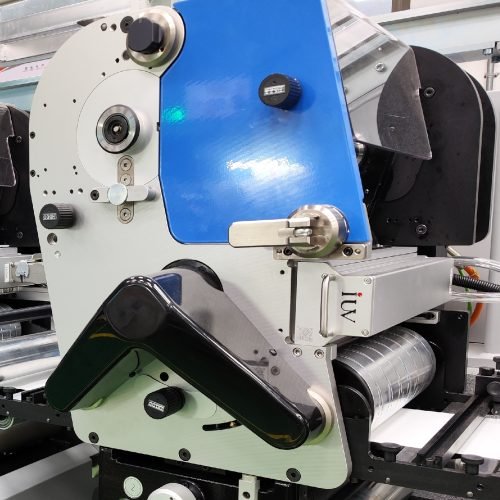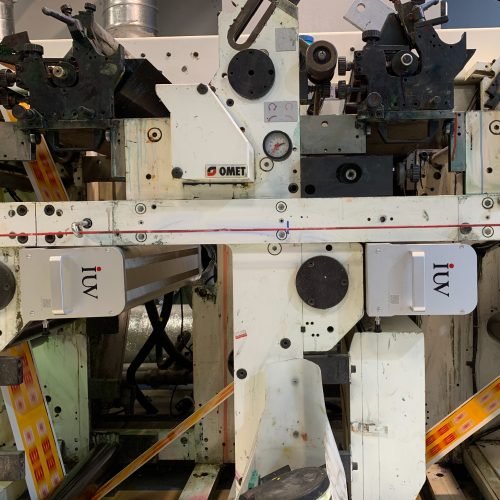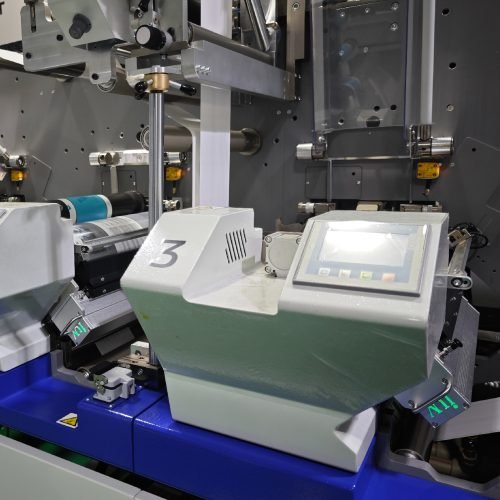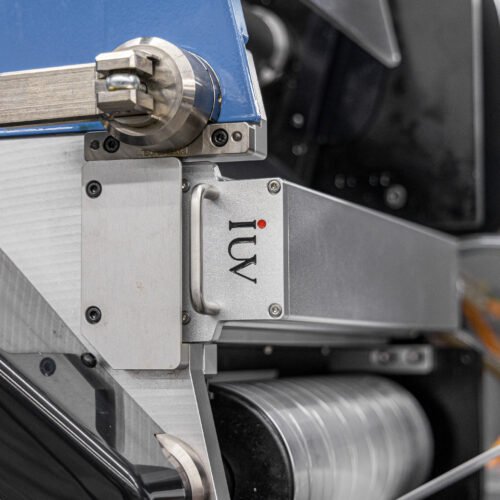
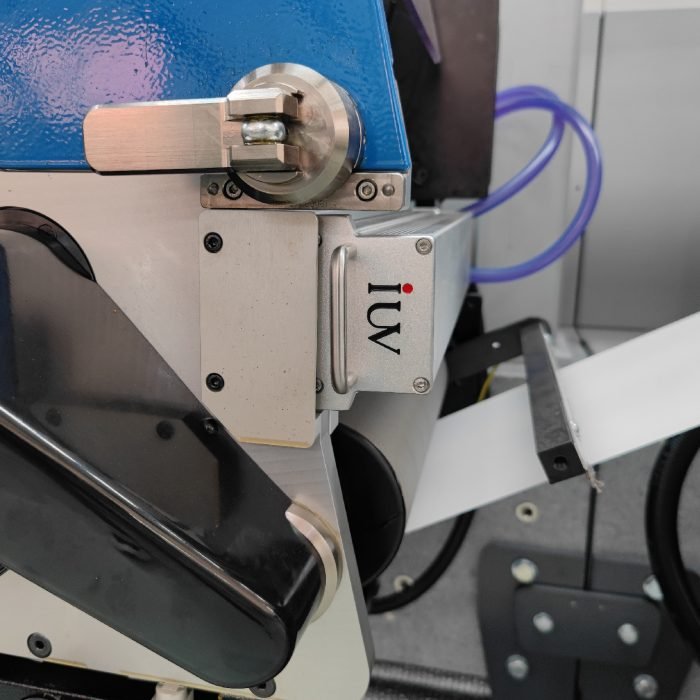
Industrial LED UV systems for labels must deliver enough energy to cure the ink film fully while keeping the web temperature within the substrate limit. This balance is critical in narrow-web flexographic printing, offset label printing, and converting of pressure-sensitive materials. Excess curing power can distort thin films, weaken adhesive layers, increase curl, or create register variation. Insufficient power can leave uncured ink, odour, poor rub resistance, and migration risks.
Correct sizing is not based on lamp power alone. It depends on wavelength, irradiance, dose, ink chemistry, anilox volume, web speed, substrate construction, and cooling design. A practical system must be matched to the actual press process, not only to a theoretical curing target.
Introduction
Label converters in Italy increasingly use LED UV curing for self-adhesive labels, shrink sleeves, wrap-around labels, and specialty narrow-web applications. The technology can reduce heat transfer compared with conventional UV lamps, but it does not eliminate thermal risk. A high-output LED head can still heat a sensitive labelstock through absorbed radiation, hot-air recirculation, web contact, and accumulated heat in the press enclosure.
The engineering question is therefore not simply how much power is available. It is how much useful curing energy reaches the ink layer, at the correct wavelength, before the substrate temperature exceeds its safe operating range.
This issue becomes more demanding with thin PE and PP films, thermal paper, unsupported films, metallised materials, and label constructions with pressure-sensitive adhesives. It also affects jobs with dense solids, opaque white, high anilox volumes, multiple colours, and low-migration requirements.
The Difference Between Irradiance and Curing Dose
Irradiance is the optical power delivered to the surface at a given moment. It is commonly expressed in W/cm². A high irradiance level creates a strong polymerisation response and is particularly important for surface cure, high-speed printing, and difficult ink systems.
Curing dose is the total energy received by the ink layer. It is generally expressed in J/cm². Dose depends on irradiance and exposure time. When web speed rises, exposure time falls. The curing unit must then provide sufficient irradiance, sufficient exposure length, or both.
A useful simplified relationship is:
Curing dose = irradiance × exposure time
In production, this calculation is only a starting point. The actual result is affected by the distance between the LED window and the web, the optical design of the lamp head, contamination on the protective window, ink pigmentation, and the geometry of the printed image.
A dense black or opaque white ink absorbs and scatters more radiation than a transparent varnish. It may require a higher dose, but increasing lamp output without controlling web temperature can damage the label material. The correct approach is to improve energy efficiency before increasing nominal electrical power.
Selecting the LED Wavelength for the Ink System
Most industrial LED UV systems for labels operate around 365 nm, 385 nm, 395 nm, or 405 nm. The correct wavelength must match the photoinitiator package used in the ink, varnish, adhesive, or coating.
A 395 nm LED system is widely used in narrow-web flexographic applications because it can support efficient curing with properly formulated LED UV inks. However, not every conventional UV ink is suitable for conversion. An ink designed for mercury lamp curing may rely on spectral components that are not present in an LED UV system.
The press team should confirm compatibility with the ink supplier before defining lamp output. The evaluation should include colour inks, opaque white, overprint varnish, adhesive coatings, and any special ink used for cold foil, tactile effects, or variable data.
Mismatch between LED wavelength and photoinitiator chemistry often creates misleading production results. The ink may appear dry at the surface but remain under-cured near the substrate. This can lead to poor adhesion, low resistance to chemicals, blocking during rewinding, or odour after converting.
Industrial LED UV Systems for Labels: Power Sizing by Ink Film Thickness
Ink film thickness is one of the strongest variables in curing power selection. In flexographic label printing, anilox volume controls how much ink is transferred. A higher-volume anilox may improve opacity or solid density, but it also increases the depth through which UV energy must penetrate.
For process colours and fine text, a lower anilox volume can often achieve stable colour with a thinner ink film. This reduces the dose required for through-cure and lowers the thermal load on the substrate. For opaque white, metallic shades, and heavy solids, a thicker film may be unavoidable. In those cases, the curing strategy must be designed around the most demanding colour station.
A practical qualification run should measure the ink film and record the anilox specification, line screen, viscosity, press speed, and LED output. The target is not merely a dry surface. The target is complete polymerisation through the film, combined with acceptable substrate temperature.
For multi-colour jobs, each station should be assessed separately. A powerful LED head after every unit is not always required. Some presses benefit from targeted high-output curing after white, dense solids, or varnish, while lower-demand stations use reduced output. Zoned control helps avoid unnecessary heat input.
Substrate Temperature Limits in Label Production
The substrate should be treated as a complete construction rather than a face stock alone. A polypropylene label film may tolerate a certain temperature, while its adhesive, liner, primer, or release coating has a lower limit. Thermal paper can darken or lose image quality. Thin PE film may stretch or wrinkle. Unsupported films can move laterally and affect register stability.
The most relevant measurement is the real web temperature immediately after curing and before the next critical process step. An infrared sensor can be useful, but it should be validated against contact measurements because surface emissivity varies between white paper, clear film, metallised film, and glossy varnish.
The safe temperature threshold should be defined for each label construction. It should include a process margin for ambient temperature, long production runs, and heat build-up inside the press. A short trial at low ambient temperature may not reveal the thermal behaviour of an eight-hour production run.
Web tension should also be monitored. When a filmic substrate warms, its modulus can change. This can alter web stretch, repeat length, die-cut alignment, and register performance. A curing setting that looks acceptable at the first printing unit may produce variation after several stations.
Thermal Management Beyond Lamp Output
Good thermal management starts with optical efficiency. The LED head should be installed at the manufacturer’s recommended working distance. Increasing the distance reduces irradiance and may encourage operators to raise output unnecessarily. Reducing the distance too far can create uneven exposure or mechanical clearance risks.
The LED unit itself needs stable internal cooling. Water-cooled systems require controlled coolant flow, clean heat exchangers, and alarm monitoring. Air-cooled systems need clean filters, adequate airflow, and clearance around the lamp housing. If the LED junction temperature rises, output may decrease or become unstable.
The press enclosure also matters. Warm air trapped around the web can become a larger heat source than the radiation itself. Local extraction, directed cooling air, and separation between curing stations can reduce accumulated heat. Cooling airflow should not disturb the wet ink before cure or create dust contamination.
Chill rollers can be useful when running sensitive films. Their placement must be considered carefully. Cooling after the cure zone can stabilise web temperature, but excessive cooling before complete curing may affect ink flow or condensation risk in humid conditions.
Oxygen Inhibition and Surface-Cure Defects
Oxygen inhibition can reduce surface cure in certain UV formulations. The issue is more visible in varnishes, low-migration coatings, and some highly pigmented inks. Typical symptoms include tackiness, poor rub resistance, reduced gloss, and blocking on the rewind.
Increasing LED power may improve the result, but it can also raise the temperature of the web. Before changing power, confirm that the ink is LED-compatible and that the wavelength is correct. Check the LED window for contamination, verify the lamp-to-web distance, and inspect whether the ink film is too thick.
In difficult cases, an inerting solution can reduce oxygen at the curing interface. Nitrogen-assisted curing may improve surface polymerisation at lower effective thermal stress. It should be justified by the application, especially where low migration, high rub resistance, or demanding package compliance is required.
Low-Migration Requirements and Verification
Food, pharmaceutical, cosmetic, and sensitive consumer-product labels require careful curing validation. A label can pass a basic finger-touch check while still containing insufficiently cured components. Low migration depends on the complete system: ink formulation, substrate, adhesive, printed coverage, curing conditions, and intended end use.
For these applications, the converter should establish controlled production settings. The operating window should define maximum press speed, minimum irradiance, curing-head distance, and acceptable substrate temperature. Changes to anilox, ink supplier, lamp head, or labelstock should trigger a new technical review.
Routine checks can include rub resistance, adhesion, odour assessment, blocking tendency, and documented curing settings. For critical label applications, verification should follow the customer’s compliance process and the approved ink system.
Troubleshooting Common LED UV Curing Problems
Poor adhesion may indicate insufficient through-cure, unsuitable photoinitiators, contamination on the substrate, or excessive ink film thickness. First inspect the ink system and curing geometry before increasing power.
Tackiness after curing can result from oxygen inhibition, low dose, poor wavelength matching, or a dirty LED window. If tackiness appears only in heavy solids, the anilox volume and opaque pigment load should be reviewed.
Film distortion or label curl usually indicates excessive heat exposure or uneven thermal distribution. Lowering output may help, but a better solution can involve staged curing, zoned lamp control, improved cooling airflow, or a thinner ink film.
Register variation on filmic labels may be caused by web heating and tension change. Monitor temperature by station and compare it with register movement. If the variation rises during a run, thermal accumulation in the curing enclosure is likely involved.
Retrofit Conditions for Existing Narrow-Web Presses
Retrofitting industrial LED UV systems for labels requires more than replacing lamp heads. The press must provide suitable electrical capacity, cooling infrastructure, mechanical clearance, and safe integration with guarding and interlocks.
The cure position should be evaluated in relation to print units, chill rollers, web path, and die-cutting stations. The lamp should cure the ink effectively without exposing sensitive components to unnecessary heat. Existing reflectors, shutters, or conventional UV ventilation arrangements may not be appropriate for LED UV operation.
A retrofit project should begin with representative production jobs. These should include the fastest standard job, the highest-coverage solid job, a sensitive filmic labelstock, and any regulated low-migration application. The resulting process window provides a more reliable basis for equipment sizing than a single laboratory sample.
Conclusion
Correctly sizing an LED UV curing system for label printing requires a balance between polymerisation performance and thermal control. Irradiance, dose, wavelength, ink-film thickness, web speed, and cooling design must be considered together.
The most reliable approach is to define curing settings around the hardest real production job, then confirm that the substrate remains stable during extended runs. Efficient optical delivery, controlled ink transfer, LED-compatible chemistry, and active heat management reduce the need for excessive lamp output. This protects sensitive label materials while maintaining cure quality, registration stability, and converting performance.